

Indicators are tools to evaluate and guide the implementation of strategic directions and the achievement of strategic objectives. These indicators include measures for each strategic objective, the typology and demand for digital technologies, the status of drivers and barriers, and the digital maturity level of the industry. They provide evidence on how the adoption of the strategic directions can increase digitalisation of the sector, demonstrating the potential benefits of a more coordinated approach.
Typology of DigiTech in the Construction Industry
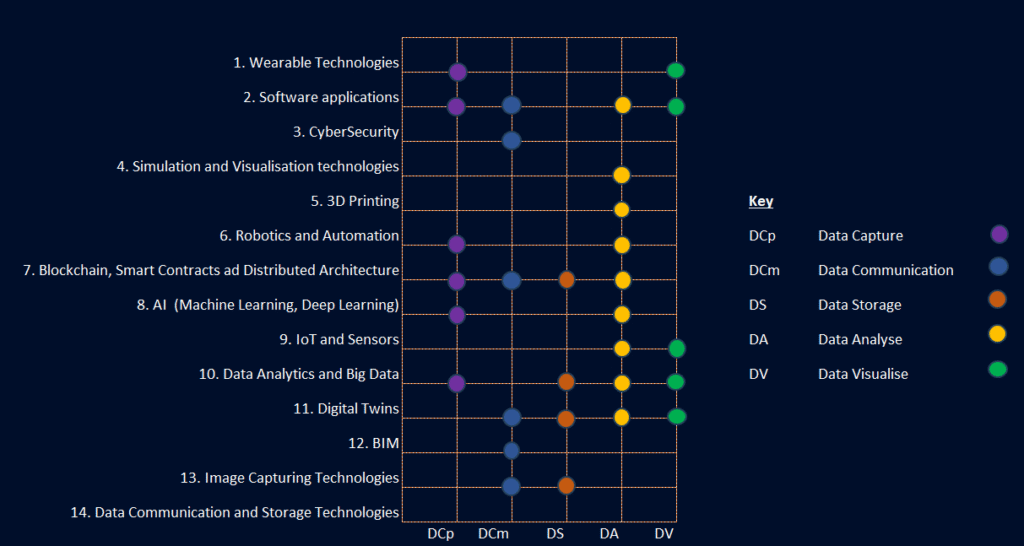
Identifying existing technologies and their demand in the construction industry is a crucial step when developing digital policies. This is important because of:
Through a comprehensive literature review, fourteen (14) technologies currently available in the Australian construction industry were identified. These technologies were categorised into five groups based on their primary functionalities. It is important to note that individual technologies rarely operate in isolation; they must function collaboratively to achieve optimal task performance. This categorisation helps identify complementary technologies that can be integrated to enhance overall system efficiency and effectiveness.
Data Capturing Technologies: These tools and systems collect raw information from the physical environment or humans and convert it into digital formats for processing
Data Communication Technologies: These technologies enable the transfer of data between devices, systems, and stakeholders across physical or cloud networks.
Data Storage Technologies: Data storage technologies offer secure, scalable, and accessible systems for storing and retrieving information.
Data Analysis Technologies: These technologies process and interpret data to extract meaningful insights and support decision-making.
Data Visualisation Technologies: These tools transform data into graphical and interactive formats for easier understanding and communication.
Grassroot Level Demand Analysis of Technologies for Construction Tasks
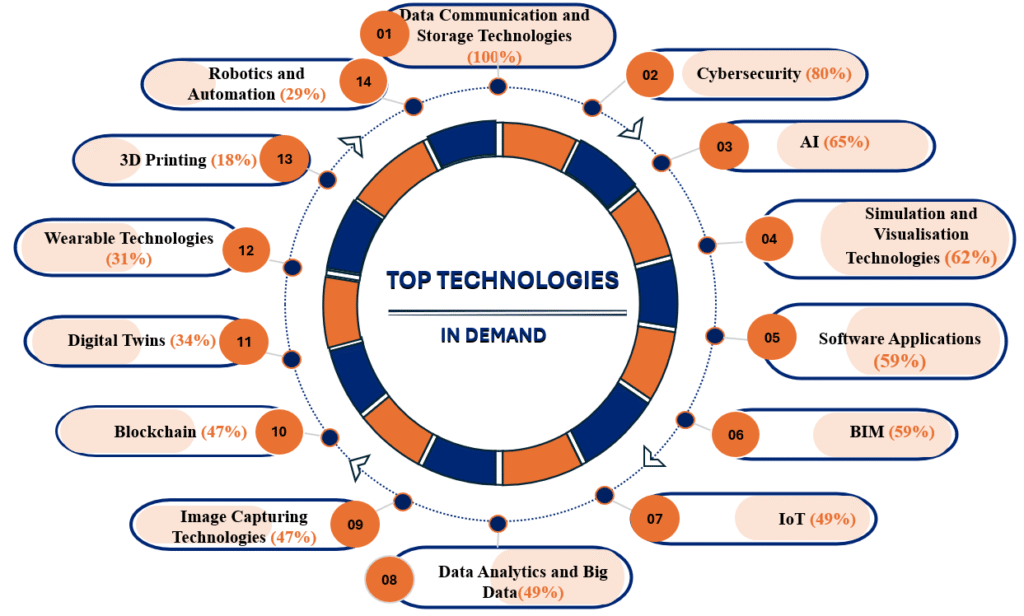
When conducting the grassroot demand analysis for technologies, it is identified that construction professionals have limited knowledge of technologies. While many construction professionals are proficient in using different types of software, their understanding of the technology behind these tools is limited. Thus, professionals were asked to list and rank the software they use for each construction task, which was then mapped to underlying technologies to analyse.
Based on the demand analysis, Data Communication and Storage Technologies received the highest demand (100%), followed by Cybersecurity (80%) and AI (Machine Learning, Deep Learning) (65%). Technologies like Simulation & Visualisation (62%), Software Applications (59%), and BIM (59%) also show strong interest. Moderate demand is seen for IoT and Sensors and Data Analytics & Big Data (both 49%). Blockchain and image-capturing technologies demonstrate a 47% demand. In contrast, 3D Printing (18%), Robotics & Automation (29%), and Wearable Technologies (31%) show relatively lower adoption.
Digital Skills Required for Adopting Digital Technologies
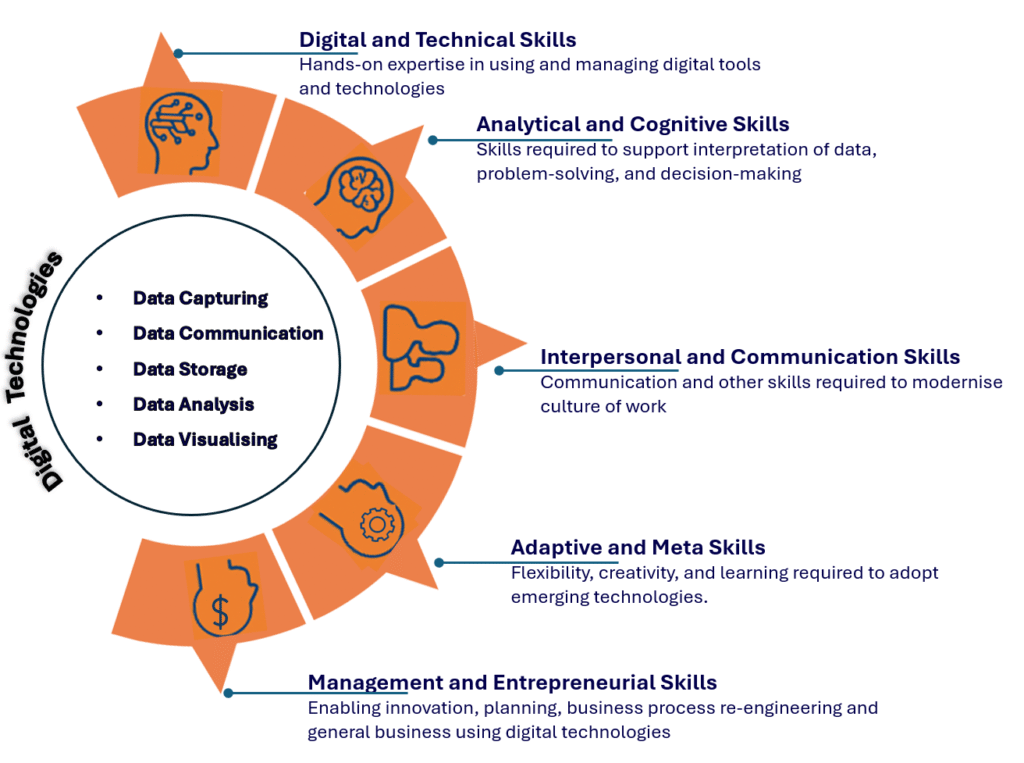
Digital skills are a critical component of any policy framework for digitalisation, as technologies alone cannot drive transformation. People must have the capability to apply these tools effectively. Even the most advanced technologies will fail to deliver value without the right skills in place.
Integrating these categories into the policy framework is vital, as it aligns workforce capabilities with the technical demands of digital technologies. This alignment enables targeted skill development, smooth technology integration, and supports the long-term digital maturity of the industry.