

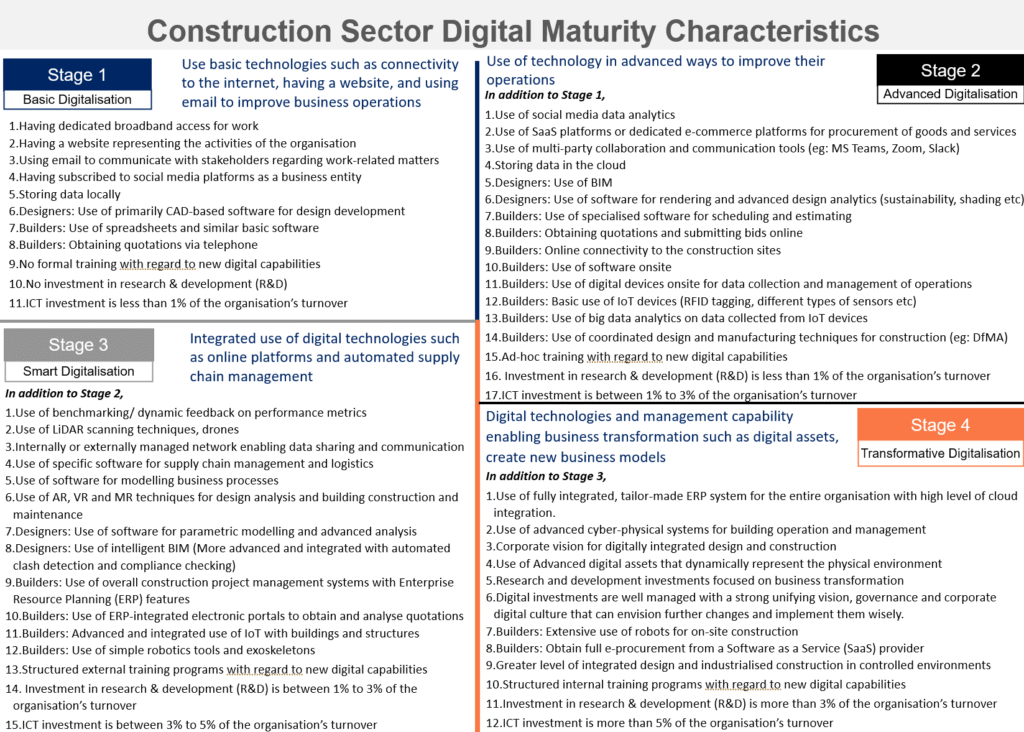
The level of digital maturity is an indicator of the digitalisation of the construction industry. The DigiCon policy directions framework adopts the digital maturity model proposed by Perera et al. (2022), which defines four progressive levels of digitalisation within the construction sector: Basic Digitalisation, Advanced Digitalisation, Smart Digitalisation, and Transformative Digitalisation. Each level is characterised by distinct capabilities, processes, and technology adoption patterns.
Consistent with the findings of Perera et al. (2022), the majority of interviewees in this study indicated that the NSW construction sector predominantly remains at the Basic Digitalisation level, reflecting limited integration and use of advanced digital technologies across the industry.
IT Infrastructure & Digital Capability of Designers and Builders
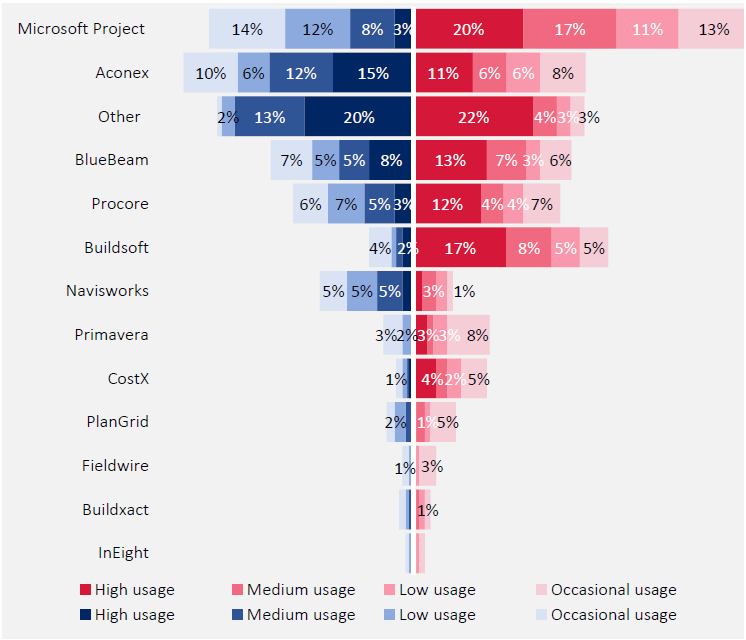
Use of document management and project management software
Microsoft Project for schedule management, Aconex for document management and Buildsoft for cost management are the most popular software used by designers and builders, as shown in Figure 3.11. 37% of the designers and 61% of builders use Microsoft Project while Primavera is used by a significantly lesser number of organisations (5% and 14% respectively). Nearly 42% of designers and 31% of builders use Aconex as a document management software. This is followed by Procore which has overall 27% usage. Buildsoft is used by over 35% of the builders followed by Aconex with over 32% and BlueBeam over 29%. Cost management software does not seem to be much used by builders except for Buildsoft which is used by 35% at various levels. However, the survey only focuses on designers and builders and expressly excludes quantity surveyors working in the consultancy sector. Furthermore, builders use MS Project significantly more while designers use Aconex significantly more. Micro and small designers and builders use MS Project and Aconex significantly less than medium and large players.
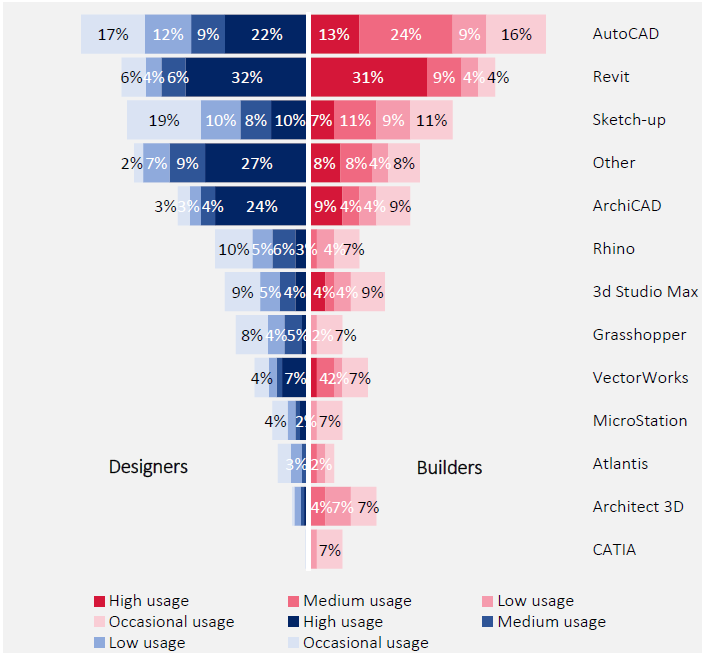
Software used for class 2 building designs and as-built drawings
AutoCAD, Revit and SketchUp are the most popularly used software for building design and as-built drawings. Two thirds (60%+) of designers and builders use AutoCAD followed by Revit, SketchUp and ArchiCAD (see Figure 3.10). One third (31%) of designers have a very good level of usage of AutoCAD (Medium – High). Usage of Revit is high in around a third (32%) of designers followed by high usage of ArchiCAD by a quarter (25%) of designers. There is no significant difference between designers and builders in their usage level of the identified popular software.
Drivers and Barriers for Digitalisation
Drivers
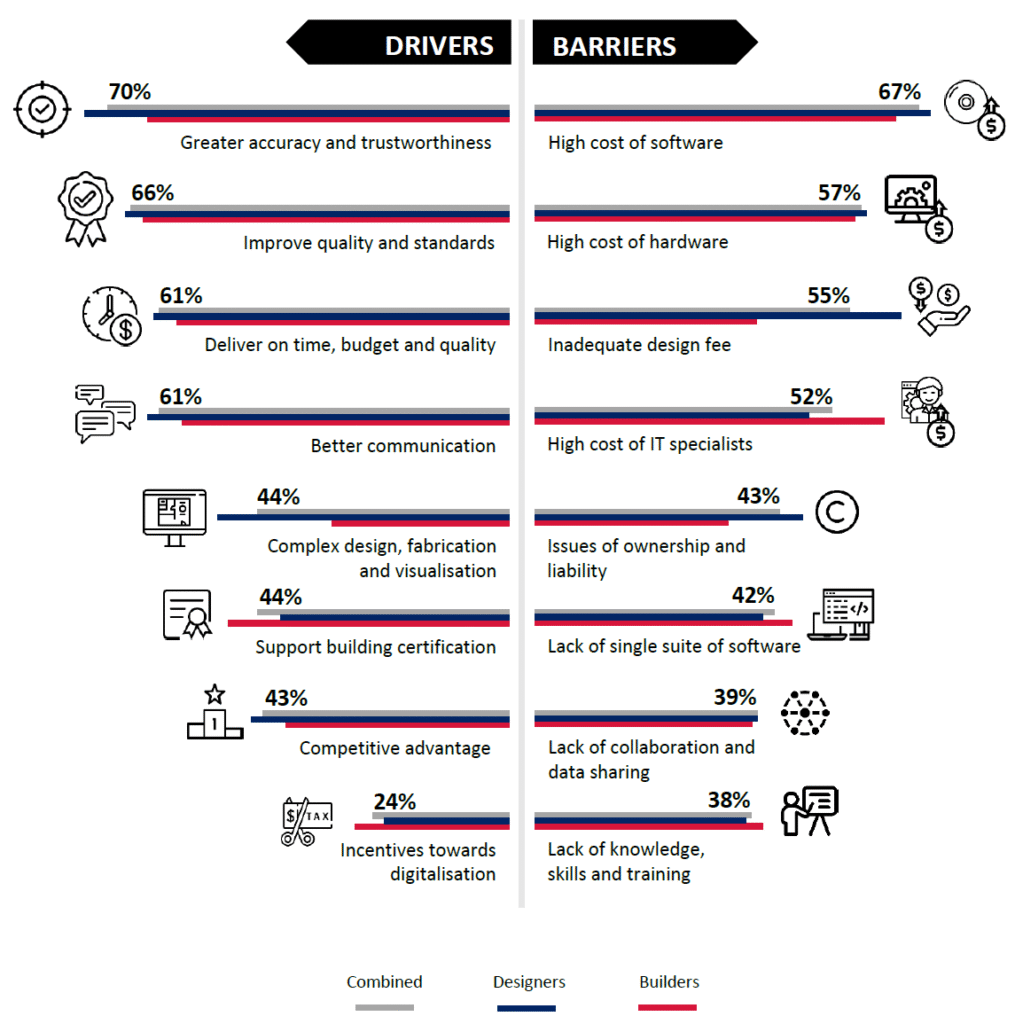
Achieving a greater level of accuracy and trustworthiness is the highest-rated driver selected by respondents. This symbolises two of the most impactful factors that hinder the performance and function of the construction industry. It is expected that digitalisation will improve these deficiencies significantly.
The second most highly rated driver is improving the quality and standards in construction. Digitalisation helps eliminate errors and improve quality and standards. It is closely followed by the ability to deliver complex projects within budget, time and prescribed quality and better communication between stakeholders. It is interesting to note that, although still considered a driver, Incentivising/ providing tax benefits to organisations moving towards digitalisation is deemed to be the least important driver for digitalisation.
Barriers
Understanding how the industry players feel about barriers to digitalisation of their organisations provides a crucial insight into developing a strategy for digitisation. High cost of software purchase/licensing is considered the most important barrier, including price and non-price conditions that create impediments to switching. This is followed by the high cost of digital tools and setting up equipment. Both designers and builders feel that the cost of software and hardware seems to make digitalisation more difficult. Inadequate design fee to support digital innovation is the third most rated barrier for digitalisation, mainly because it was deemed as the second biggest barrier by Designers, although it was only ranked sixth by Builders. The High cost of IT specialists was rated the fourth biggest barrier, as it has been ranked as the fourth and the second biggest barrier by designers and builders, respectively.
Proposed Strategic framework for digitalisation of design and construction (SFDDC)
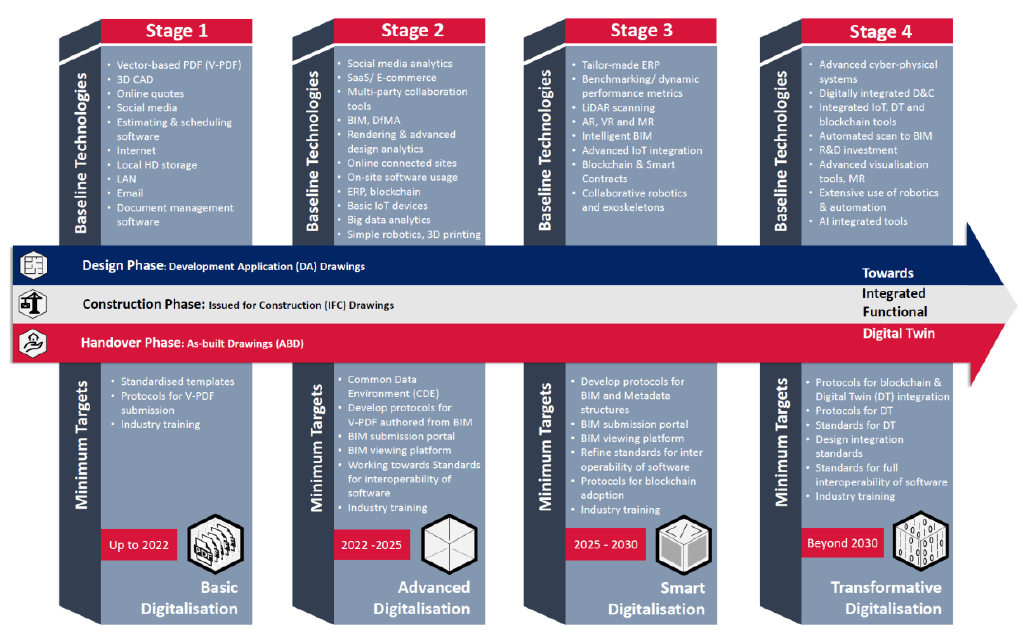
Stage 1: Basic Digitalisation (up to 2022)
Stage 1 indicates the basic level of digitalisation that needs to be achieved by 2022. It is characterised by the use of basic technologies such as connectivity to the internet, having a website, using email to improve business operations and the use of vector-based PDF or 3D-CAD. This stage involves the achievement of standardised templates and protocols for V-PDF and 3D-CAD submissions.
It is evident that the whole sector could achieve use of PDF by 2022 without it being an overwhelming burden to the industry, in particular, to micro and small enterprises. To achieve 3D CAD by 2022, only 30% of organisations would be pushed harder than their normal trajectory of advancement. Therefore, it is recommended that all designs, IFC and ABD submissions be in Vector-based PDF format on a standard template implemented across all jurisdictions in NSW.
There are implications for the public sector drawing evaluation authorities (and NSW Planning portal). These organisations would also need to develop not only capabilities to accept Vector-based PDF formats but fluency and capacity to effectively use them to evaluate submitted drawings. However, this should not be overwhelmingly burdensome as the required IT capability enhancement would be minimal. The main aspect would be to train staff to be able to effectively use the 3D Vector-based PDF drawings.
Stage 2: Advanced Digitalisation (2022 to 2025)
Stage 2 indicates an advance level of digitalisation that needs to be achieved by 2025. It is characterised by the use of technology in advanced ways to improve their operations both as a design and/or construction organisation. This stage envisages the use of technologies such as SaaS and cloud-based software, data analytics, BIM, DfMA processes, rendering and advanced design analytics, ERP systems, basic IoT devices, basic blockchain systems, 3D printing, simple robotics, among others. Stage 2 also indicates the targets of achieving a common data environment (CDE), BIM submission portals, BIM viewing platforms and working towards interoperability of software.
The next stage of natural technological advancement is for the industry to move towards BIM capability. The data indicates that 74% of the industry would have achieved BIM capability in their natural course of progression by 2025. Therefore, this would push the balance 26% of the industry much harder than they would have naturally progressed. This appears achievable with good regulation, training and a strategic approach to development.
Designs being authored through BIM software would help to enable greater consistency and coordination. IFC submission in a Common Data Environment will need to be in BIM format. It is also expected that BIM format will be used for ABD certification and submissions to client. The development of standards for interoperability of software and achieving a Common Data Environment is vital for success at this stage. As such it will require skill enhancement of the workforce to evaluate BIM submissions as well as enhancing the portal capacity to accept BIM format submissions. Adopting this strategy will eliminate the need for the 76% of the industry to downgrade their already BIM enabled designs.
Stage 3: Smart Digitalisation (2025-2030)
Stage 3 indicates the smart use of digital technologies across the sector that needs to be achieved by 2030. This stage will see rapid proliferation of technologies across the industry where buildings become smarter and intelligent. It is characterised by online platforms and automated supply chain management systems and the use of technologies such as advanced ERP systems, LiDAR scanning technologies, AR, VR and MR visualisation technologies, intelligent BIM, collaborative robotics, advanced blockchain and smart contracts-based systems. Minimum targets to achieve includes the development of BIM and metadata structures, BIM submission portals, Blockchain adoption protocols and more refined standards for interoperability of software.
The last half of this decade will see the boundaries of technological advancement further pushed into achieving smarter and intelligent BIM capability. The survey data indicates that 85% industry would have achieved BIM capability by 2030. As such this benchmark will only push the remaining 15% of industry harder than their natural state of progression to achieve this level of digitalisation in building design.
Designers would be required to submit their designs in advanced BIM formats incorporating metadata such as cost, schedule, and environmental evaluation data integrated BIM formats for IFC and project implementation and client evaluation. ABDs would need to be submitted in BIM format for approval purposes, but builders would be encouraged to submit BIM with Facilities Management (FM) data to their clients. This would enable building clients to use it as the basis for the ongoing management of the building. This period will involve consolidation of protocols for use of BIM and development of standards and protocols for used for additional metadata and FM data submissions. It would also involve refinement of standards for interoperability of software. A major drive in training the workforce and certification of capabilities would be needed at this stage.
Stage 4: Transformative Digitalisation (beyond 2030)
Stage 4 indicates rapid and broad transformation of the construction sector to embedded digitally driven processes that will be achieved beyond 2030. This stage will be characterised by the technologies such as advanced cyber-physical systems, automated scan to BIM, digital twins that provide building automation, advanced visualisation tools, extensive use of robotics and automation, AI integrated tools, blockchain based integrated supply chains governed by advanced smart contracts and digital tracking with IoT devices. The development of protocols for DT, blockchain system governance, standards for advanced building management systems, standards for design integration and full interoperability of software will be key minimum targets. This stage warrants the re-think and development of the next decadal plan for the construction sector.
The new decade would involve the proliferation of digital capabilities in the construction industry truly moving into advanced stages of the fourth industrial revolution. It is expected that this stage would involve the evolution of truly smart and intelligent buildings with self-awareness being brought in through incorporation of sensors into buildings. Integration of sensors and IoT devices to buildings will enable digital twin to operate in its full potential. Survey data indicate that the balance 29% of the designers and builders would achieve digital twin capabilities in this period. This period would require the further development of standards for digital twin as IoT and sensor technologies and data exchange and communication technologies mature. Continued training of the workforce and incorporation of new skill sets into building design and management would occur as these technologies get embedded into buildings.